RS and RKO rules: practical application
Radar equipment: installation conditions on the bridge
After selecting the location of the screen, another question remains: where to place the transmitter and the remaining radar units. Free space under the console does not mean that any block is allowed there. For radar equipment on the bridge, the RS Rules link the solution to the electromagnetic situation and noise, and if conditions are not met, provide for a separate room.
Scope and conditions of the requirement
The relevant clause is 3.4.6.2 of Part V, Navigation Equipment, of the RS Rules for the Equipment of Sea-Going Ships. Under clause 1.1.1, this Part applies to self-propelled ships not engaged on international voyages. The regulatory framework for international voyages must be established separately. Additional flag-administration instructions are taken into account under clause 1.1.3 and take precedence in the event of conflict.
Clause 3.4.6.2 permits the transmitter and other radar equipment to be located on the navigation bridge provided that high-frequency emission power-flux density, mechanical noise and electrical interference to radio reception remain within permissible limits. If these conditions are not met, a dedicated enclosed, shielded equipment room is required.
This is a conditional provision. It does not unconditionally require every radar's electronics to be moved to a separate room. Equally, an enclosed housing, convenient mounting or a 'marine' label does not establish compliance with the three conditions listed.
Why the rated power alone is insufficient
KODEN MDC-7912P is a marine radar with a manufacturer-stated power of 12 kW. This specification concerns the radar's transmitting section. It cannot directly be treated as power-flux density at a particular point on the bridge: these are different quantities. Nor can it determine mechanical noise at the watchkeeping position or interference to an operating radio receiver.
First establish the contents of the actual package and the physical arrangement of its units from the manufacturer's documentation. Do not assume this model has a separate under-console transmitter unless that configuration is documented. The design must describe the actual units, their locations, cable routes and surrounding equipment.
What to check for modernization
Record the existing layout before dismantling. The unit list needs exact designations and versions; photographs must identify the compartments and working positions. Mark nearby radio equipment, power supplies, ventilation and equipment to be retained.
Based on the documentation and the project, determine what confirms the admissibility of the selected place for each of the three factors. If measurements are needed, agree in advance on their terms and criteria with the responsible designer. In 3.4.6.2, there is no universal number that can be written for any bridge or receiver without additional reason.
After installation, check the project modes. A quiet cabinet turned off and a working radar are different conditions; normal reception when equipment is stopped does not yet prove the absence of interference during its operation. The detected defect is eliminated for real reason and documentation, while maintaining the requirements for power supply, grounding and maintenance.
How to formulate an application
| What to put in | What does it make clear? |
|---|---|
| Class, vessel design and operating area | Scope of rules and additional requirements |
| Unit schedules for the existing and new radars | Actual configuration of equipment |
| Bridge and equipment-room plans, with photographs of the locations | Possible installation locations |
| Composition of neighboring radio equipment | Conditions for checking radio interference |
| Available test reports and observations | What data is already available and what is missing |
Please specify the delivery, design work, installation and necessary inspection. This way the quotation responds to the placing task, not just the radar price. The availability of the product, approval of the configuration and compliance of a particular installation are confirmed by their own documents.
Sources
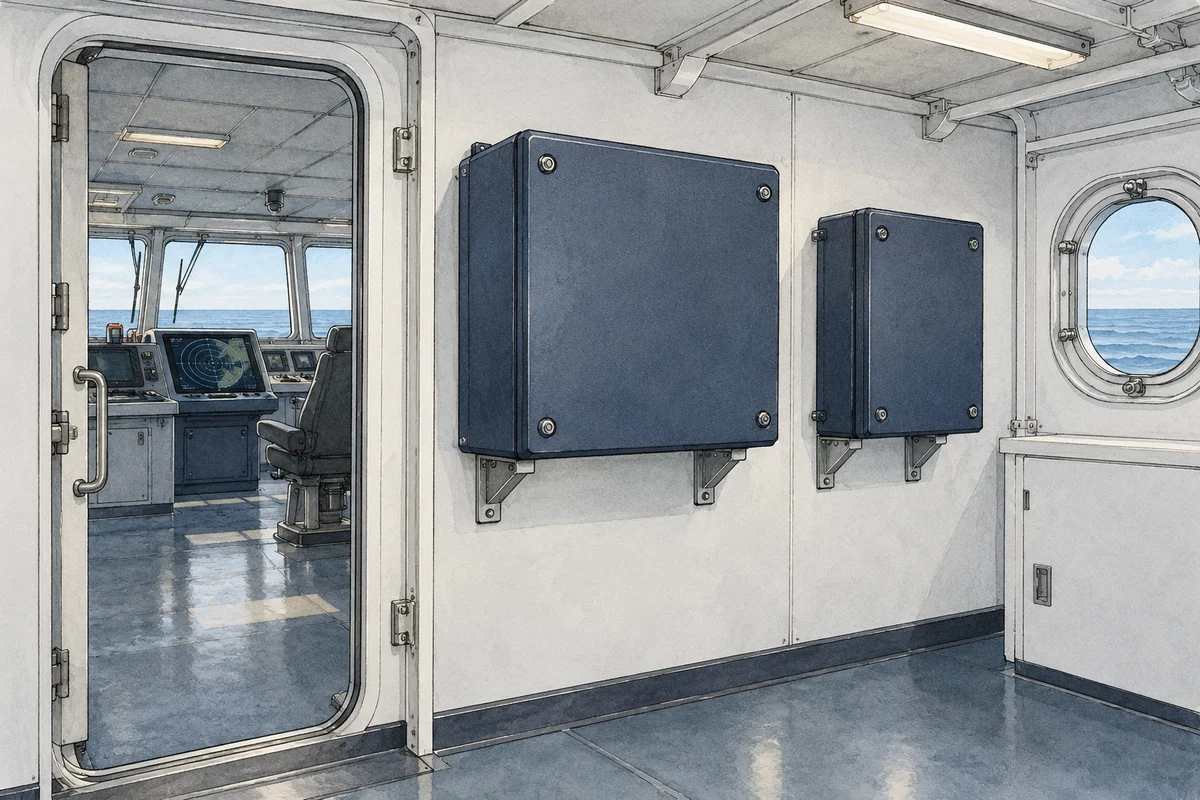
The normative basis the official Part V of the RS Rules, clauses 1.1.1–1.1.3 and 3.4.6.2. The model's marine application and main specifications are given on the KODEN MDC-7912P page. The schematic equipment-room drawing does not specify the product design or demonstrate measurement results.