RS and RKO rules: practical application
Watchkeeping monitoring: who must receive the alarms?
Selecting BNWAS alarm devices starts with recipients and their locations. Four devices in a box do not establish where an alarm will be audible or who can respond. An alarm schedule links each stage to specific stations and compartments aboard the vessel.
Requirements in clauses 3.4.7.4–3.4.7.5
The basis is Part V, Navigation Equipment, of the RS Rules for the Equipment of Sea-Going Ships, edition 01.01.2026. Under clause 1.1.1, its scope is self-propelled ships not engaged on international voyages. Establish the applicable framework for other operating conditions separately. Additional flag-administration instructions are applied under clause 1.1.3 in the event of conflict.
Clause 3.4.7.4 distinguishes a visual indication and three audible-alarm stages. After the dormant period, the visual indication must be visible from every bridge working position. The first-stage audible alarm must be heard at all bridge working positions. The second stage is intended for the backup officer and/or master at their locations. The third stage must sound where other crew members capable of corrective action are located.
Each requirement needs its own assessment. A visible indicator does not establish audibility, and audibility at the main console does not establish coverage of every bridge working position.
A specific option for a non-passenger ship
On non-passenger ships, clause 3.4.7.5 permits the second-stage alarm to sound simultaneously at the locations of both second- and third-stage recipients. With this arrangement, the third-stage alarm may be omitted.
This is a conditional option. It does not mean that the third stage is always unnecessary or that the arrangement may be extended to a passenger ship without a separate basis. The diagram and test programme must identify the arrangement used and who actually receives the second-stage alarm.
Device count does not establish coverage
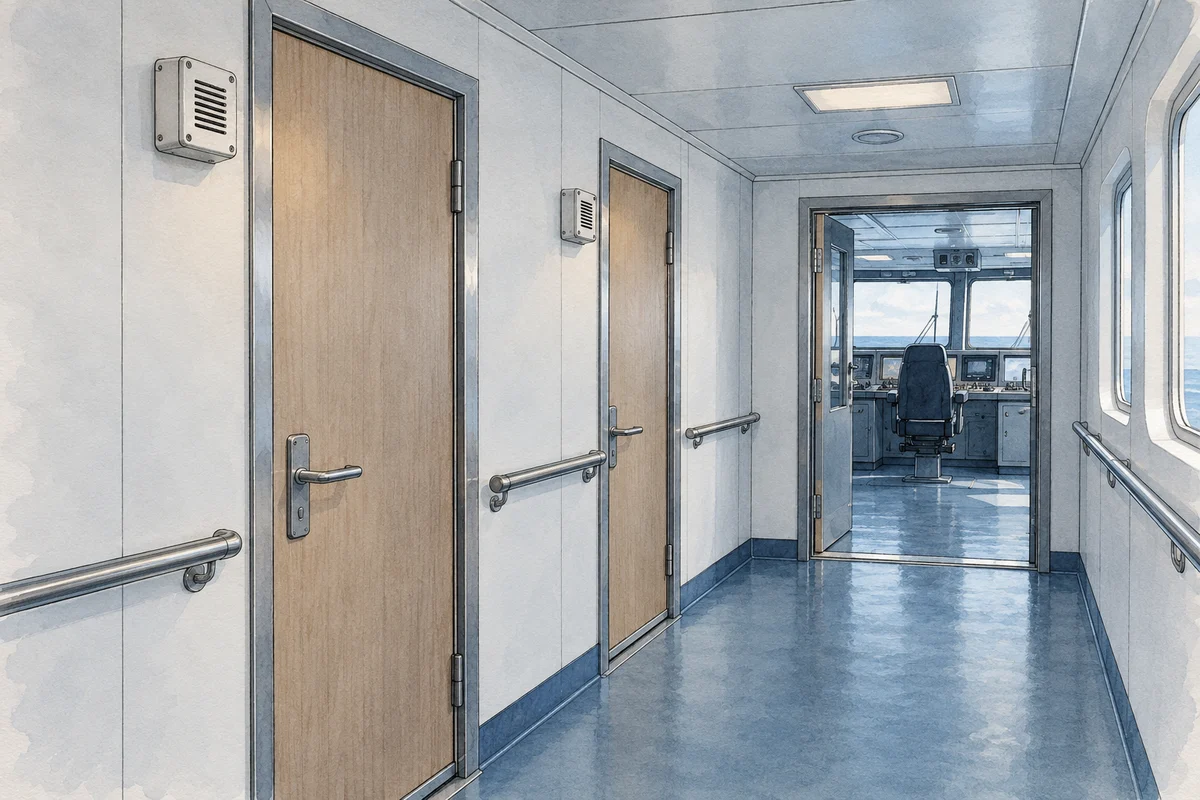
For each compartment, identify the recipient, assigned stage and actual audible-device location. Assess audibility at the intended position of the person, taking account of operating conditions and door positions. An illustration of a device beside a door does not establish audibility inside the compartment.
Required coverage follows the vessel design, rather than the maximum number of unit outputs. Nor may a standalone sounder rating be applied to an entire compartment without assessing the actual installation. Define acceptance conditions and methods from the applicable documentation.
A modular-system example
NSR NBW-1000 is an actual marine BNWAS with separate control, distribution, acknowledgement and alarm units. NAV Marine group catalogue: NSR NBW-1000 BNWAS. This product page belongs to another site in the group; agree the actual supply package separately.
Compare sounder quantities in a commercial package with the compartment schedule. A manufacturer's reference to a BAM/INS interface does not establish ready-made integration with any bridge system. Retaining existing devices requires their designations, documentation and an agreed diagram.
Schedule for quotation and testing
| What do I say? | Purpose |
|---|---|
| Passenger or non-passenger ship | Assess applicability of the option in 3.4.7.5 |
| All bridge working positions | Define the visual indication and first stage |
| Backup officer and/or master locations | Identify second-stage recipients |
| Locations of other designated crew members | Define the third stage or simultaneous alerting |
| Units and cables to be retained | Establish the actual upgrade scope |
Attach a compartment plan and recipient list to the enquiry. Separate device supply, alarm-system design, installation and testing of each specified stage. This provides a practical basis for a quotation and system acceptance.
Sources: the official Part V of the RS Rules, clauses 1.1.1–1.1.3 and 3.4.7.4–3.4.7.5; the NSR NBW-1000 manufacturer. The illustration shows neither an actual wiring arrangement nor verified audibility.