CF-5: received heading on a separate indicator
Ruian CF-5 is a heading repeater for a working position requiring a digital indication of vessel direction. It receives data from an external heading system and displays it to the operator. Selection depends not only on panel size and mounting location but also on the incoming data: which heading the source provides, in which message and through which interface. RadarStation offers CF-5 separately; see its product page for the price. Current availability, package contents and cost are confirmed in a quotation.
Request a quote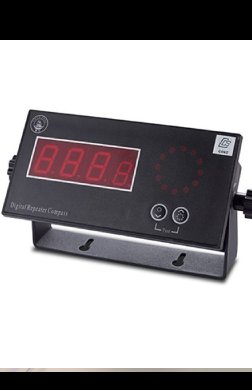
Receive heading and display it at another position
CF-5 should be considered part of the chain from heading source through data transmission to indicator. For example, an existing shipboard heading system may need to serve another operator at a different station. An additional repeater provides a remote indication; it does not perform a new direction measurement.
The source may be in another part of the ship. Therefore, the project should name not only the device that is going to buy, but also the equipment from which the information will come. For the installed system, specify the exact model and the intended output. The presence of the familiar word “compass” in the title of both positions does not prove their interfacing readiness.
HDT, HDM and HDG: value is more important than a similar number
On its specific CF-5 page, the manufacturer lists HDT, HDM and HDG messages under NMEA 0183/IEC 61162-1. HDT contains true heading and HDM magnetic heading. HDG concerns a magnetic sensor reading and may include deviation and magnetic-variation information. These are different data, not three arbitrary names for one number.
Establish which heading type the operator needs at that position and what the existing source actually supplies. Understanding several messages does not establish automatic conversion of all readings to true heading. Additional-field processing and the behaviour of a particular version must be confirmed by its documentation.
Matching numbers on two screens do not establish that the source is correct. Different readings may concern different heading types; assess them in light of data origin. Course over ground from a navigator must not silently be treated as the vessel's bow heading or substituted for the required heading message.
The interface needs to be coordinated completely.
For the CF-5, the manufacturer specifies RS-422 and a speed of 4800 baud. This information describes digital exchange, but does not replace verification of a specific source output, received message and electrical configuration of a line. The shape of the connector or the number of wires alone does not confirm compatibility.
In the application, it is useful to save one clear data route: the source designation, its output and the desired recipient. CF-5. If there is a distributor or a converter between them, it is considered as a separate part of the chain. This description allows you to discuss the actual configuration without promising connection to any available compass.
What you see on the panel
Own catalog photo shows the device with a segment digital indicator, circular light indication and bracket. You can imagine the appearance of the workplace. The image does not confirm the marking of a particular proposed specimen, its condition or a complete set of accessories.
The number of signs of the indicator does not equal the accuracy of the direction measurement by the whole system. As a result, the source sensor and the transmitted information are involved; the repeater does not convert the inaccurate initial measurement into an accurate one. Similarly, the tabular exchange parameter cannot be automatically given as a guaranteed delay of readings from the sensor to the eyes of the operator.
Wall or cut-in placement
In the published list of the manufacturer, the wall bracket and accessories of the cut-in placement are given. This is the basis for agreeing on the desired installation configuration, rather than including all default options in the order. For a particular post, an overview of the indicator and a place for the housing, mounting and connections are essential.
Send a general view of the proposed place and indicate the chosen method of accommodation. Landing and permissible installation conditions are checked according to the documentation of the proposed configuration. The presence of a CF-5 on the bracket in the photo does not mean that the supply includes the cable, the source of the heading, power supply and all the details of the attachment to the ship.
CF-5 and the price of the finished job
The price in the product card refers to a separate CF-5 in its own card. Availability, condition, documents, accessories and term are confirmed before order. If a workplace with connections and mounting is required, they are listed together with the device and the total cost of the kit is agreed upon; installation and inspection are allocated separately.
In comparison 19-F, CF-3 and CF-5 have already disassembled different problems of indication and directional. Here, the subject of quotation is more specific: a digital pointer that is agreed with a specific source and heading format. For delivery in Russia or Kazakhstan, specify the city or port, the number of devices and the required date. This maintains a clear order boundary from the data source to the workplace.
CF-5 in our catalogue
CF-5 – Digital heading repeater.
The current price is indicated in the product card. for the required set, the total price is indicated.
Request a quotePrimary source: Ruian Shunfeng: The CF-5 Exact Page, Interface, Messages and Hosting Options · Nexus HPC Compass, Edition 1.4: Section 5 - Meaning of HDT and HDG fields (format explanation only, not CF-5).