RS and RKO rules: practical application
Gyrocompass: retain access to the master unit
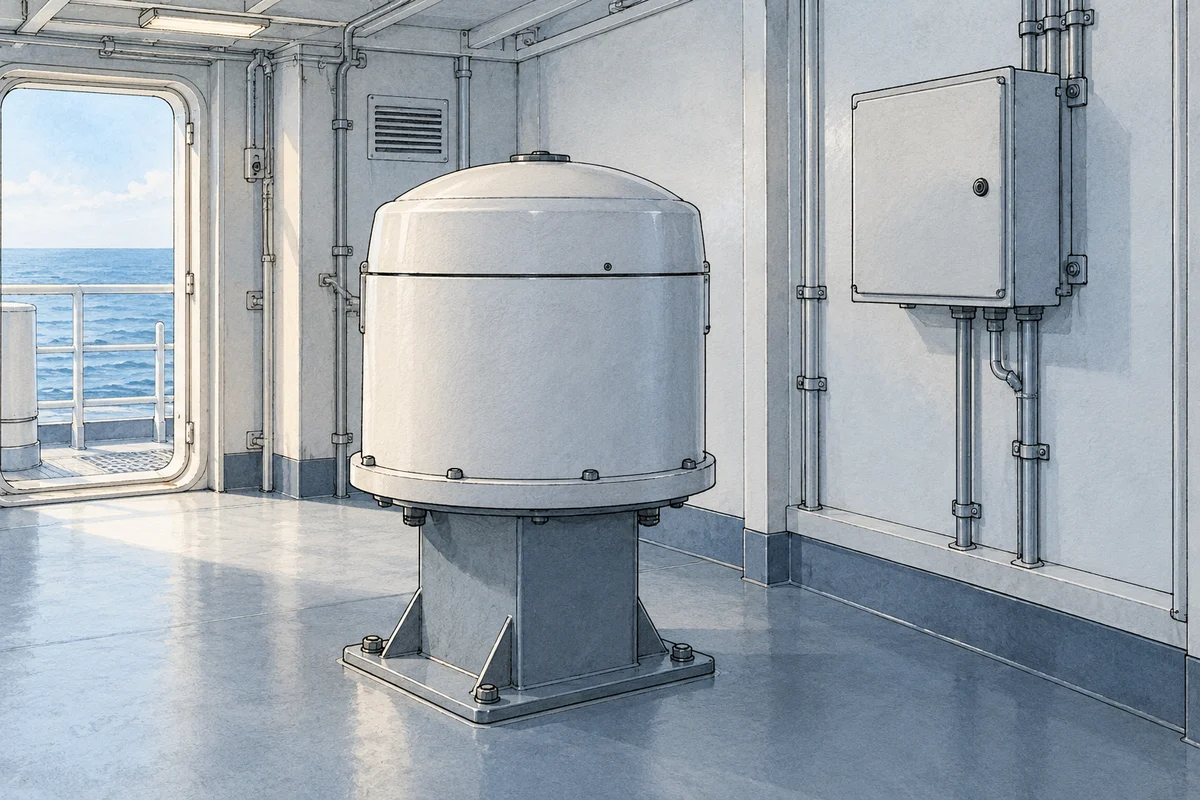
Assess a gyrocompass location by more than whether the housing fits a spare recess. After installation, the master unit must remain serviceable, with covers removable and terminals accessible. This is particularly important during upgrades when new cabinets, cable routes and mountings are added around existing equipment.
Scope of the requirement
The basis is clauses 3.4.2.1–3.4.2.2 of Part V, Navigation Equipment, of the RS Rules for the Equipment of Sea-Going Ships, edition 01.01.2026. Under clause 1.1.1, this Part concerns self-propelled ships not engaged on international voyages. Establish the framework for another vessel separately. Flag-administration instructions are applied under clause 1.1.3 in the event of conflict.
Clause 3.4.2.1 provides for the gyrocompass master unit to be installed in the wheelhouse or equipment room. Clause 3.4.2.2 requires unrestricted access, allowing covers to be removed easily and terminal blocks to be approached conveniently. Being able to see the front panel alone is insufficient.
First distinguish system assemblies
Tokyo Keiki TG-8000 is a marine gyrocompass system. Its historical parts list identifies MS-801-1 as the master unit and CB-801-1 as the Type S control unit. The product page for CB801-1 for TG-8000 must therefore be read as a separate item, rather than confirmation of supply of the complete gyrocompass or its master unit.
The historical configuration helps identify assemblies. It does not establish current approval of the particular version offered. Agree present-day package contents and required documents separately. The master-unit access requirement cannot automatically be reduced to the location of a small control unit.
Surveying the location before changing the layout
Mark the actual master unit, cover-removal directions and service connections on the plan. Compare these with installation and operating documentation for the specific system. Do not infer a universal clearance from a photograph of another installation: the requirement concerns actual service access.
Then add the new equipment and cable routes. Check the arrangement after all work is complete, rather than before a neighbouring cabinet is installed. An obstructed approach, cable above a removable cover or inaccessible terminal side may cause problems even when the gyrocompass itself has not moved.
Specialists carry out inspections and work under the documentation with the installation in a safe condition. Providing access is not an instruction for crew to open an operating gyrocompass or alter connections themselves.
Information to include in the enquiry
| Survey material | What it establishes |
|---|---|
| Master-unit and control-unit designations | Which actual assemblies are installed |
| Compartment plan and photographs from all sides | Access to covers and connections |
| Documentation for the selected version | Required maintenance actions and conditions |
| List of new cabinets and cable routes | How access changes after the upgrade |
| Repeaters and heading-data consumers to be retained | Work boundaries across the complete system |
Distinguish control-unit replacement, work on the master unit and layout changes in the enquiry. If a complete TG-8000 package is required, list its assemblies separately. This establishes supply scope and access requirements before installation begins.
Sources: the official Part V of the RS Rules, clauses 1.1.1–1.1.3 and 3.4.2.1–3.4.2.2; the manufacturer's Tokyo Keiki TG-8000/8500 brochure; historical assembly list, appendix 1. The drawing is schematic and not to installation scale.