RS and RKO rules: practical application
A new console: preserving bridge passageways
A new display may fit its front panel well, but its housing, pedestal or separate control panel changes the space around the working position. Navigation upgrades therefore require more than measuring the cut-out. Check passageways between stations, the route between bridge wings and clear height above people.
What requirements are understood
Basis -- clauses 3.2.15–3.2.18 of Part V, Navigation Equipment, of the RS Rules for the Equipment of Sea-Going Ships, edition 01.01.2026. Under clause 1.1.1, this Part covers self-propelled ships not engaged on international voyages. The regulatory framework for other conditions must be established separately. Under clause 1.1.3, flag-administration instructions take precedence in the event of conflict.
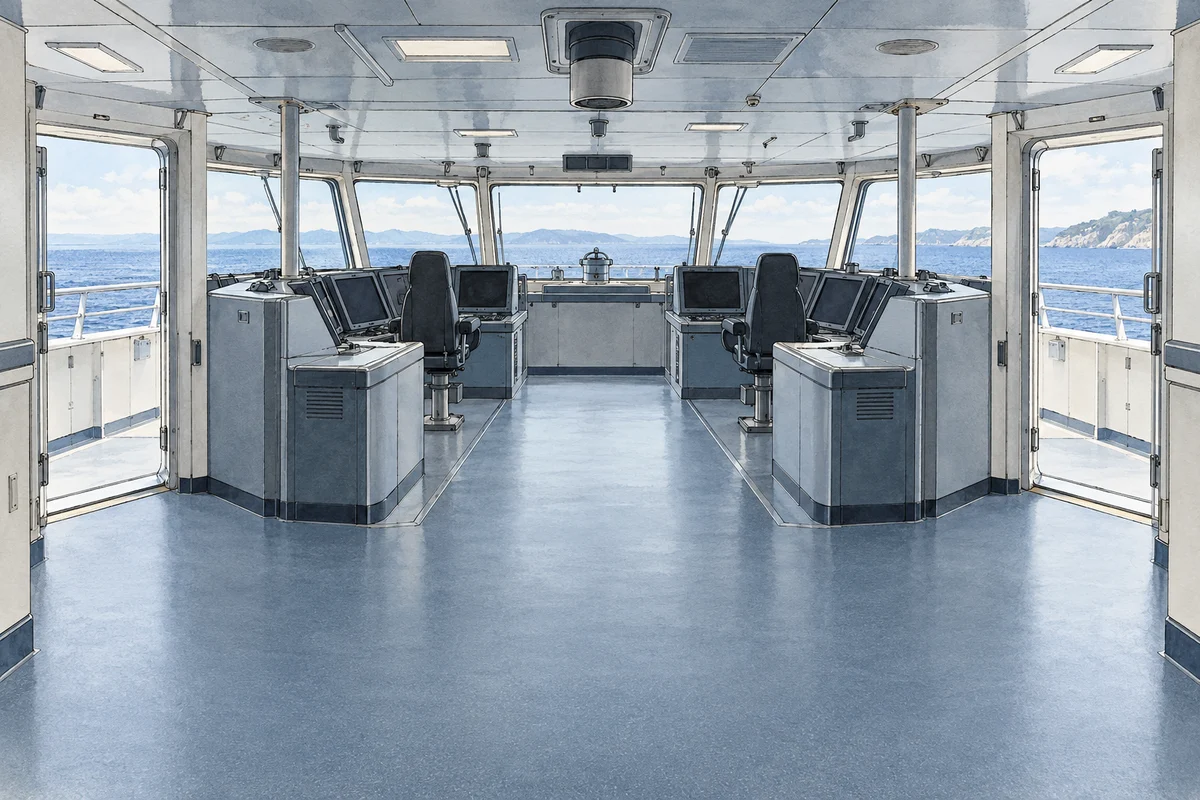
Clause 3.2.15 provides for a clear passage between the bridge wings with a width of at least 1200 mm. Clause 3.2.16 specifies a distance from the forward wheelhouse bulkhead to a console or device of at least 800 mm and passageways between working positions at least 700 mm.
Clause 3.2.16 includes important conditions. An integrated ship-control console may be positioned directly at the forward bulkhead; observation through the windows must remain possible in either arrangement. For ships with a gross tonnage below 1600 the requirements of this particular clause apply as far as practicable and reasonable. This is neither a general exemption of small ships from the entire chapter nor a condition based on vessel length.
Headroom above working positions and passageways
Clause 3.2.17 specifies a height from the wheelhouse deck covering to the lower edge of the structure of the deck above of at least 2250 mm. Under clause 3.2.18, the distance from the deck covering to the lower edge of overhead equipment above passageways, open areas and working positions must be at least 2100 mm.
These are different reference surfaces. The overall room height does not replace checking a low-mounted instrument or its mounting above a passageway. The qualification in clause 3.2.16 cannot automatically be extended to adjacent requirements.
How to account for spaced radar blocks
KODEN MDC-7912P is a marine radar with separate controls. Its layout plan must show not only the display but also the control panel, supports and actual dimensions of the selected version. This is an example using real equipment; the model name alone does not establish that a location is acceptable.
Measurements should be taken from actual projecting parts, rather than only a schematic rectangle on an old drawing. Mark opening panels, service access and neighbouring working positions separately. Additional service requirements come from the manufacturer's documentation; the stated passageway dimensions do not describe the complete installation design.
What you need to check the layout
| Data | What's checking? |
|---|---|
| Gross tonnage and vessel information | Applicability of conditions, including clause 3.2.16 |
| Bridge measurement plan | Passageways between bridge wings and between stations |
| Dimensions of all new blocks and anchorages | Actual boundaries of equipment |
| Deck-covering and deckhead elevations | Clear height at the specified locations |
| Photo of windows and consoles | Preservation of visual observation |
Specify whether the enquiry covers equipment supply alone or also layout and console modification. Agree actual package contents and drawings before fabrication, and check the completed arrangement after installation. The clear-passage illustration is not to scale and does not demonstrate compliance with the stated dimensions.
Source. the official Part V of the RS Rules, paragraphs 1.1.1. to 1.1.3. and 3.2.15. to 3.2.18. The role of the model Official website of Koden MDC-7912P.